

If you’re asking what the best CPR course options are for offices and work teams in the UK, the short answer is usually this: Emergency First Aid at Work (EFAW) is the best fit for a typical low-risk office, First Aid at Work (FAW) suits larger or higher-risk teams, and CPR/AED awareness works well as an added skill session for wider staff groups.
Why a Stand-Alone CPR Class Usually Isn’t Enough
For most office workplaces, the best option isn’t a stand-alone CPR class. It’s a workplace first aid course that includes CPR and AED use, because employer duties are based on a first-aid needs assessment, not just a wish to cover resuscitation skills. HSE guidance uses a practical framework: appointed person, EFAW, FAW, and additional training. In a very small, low-hazard office, an appointed person and a first-aid box may be enough, but once a needs assessment shows trained first-aiders are required, EFAW or FAW becomes the relevant choice.
EFAW for Low-Risk Offices and Standard Workplace Cover
Emergency First Aid at Work is a one-day, six-hour course designed for low-risk workplaces such as offices, shops and schools. It includes CPR and AED use, so a nominated first-aider can respond to a casualty who is injured or becomes suddenly unwell at work. For many office teams, this is the most practical balance of compliance, time away from work, and real emergency skills.

FAW for Larger Offices and Mixed-Risk Workplaces
First Aid at Work is a Level 3 course delivered over three days, or in a two-day plus e-learning format. It’s aimed at designated workplace first-aiders in larger teams and medium- to high-risk settings, but can also suit offices with higher occupancy, multiple floors, lone working, or a wider range of foreseeable incidents. FAW covers more than CPR: the syllabus includes AED use, choking, bleeding, shock, burns, fractures, strokes, heart attacks and poisoning.
CPR/AED Awareness as a Supplement
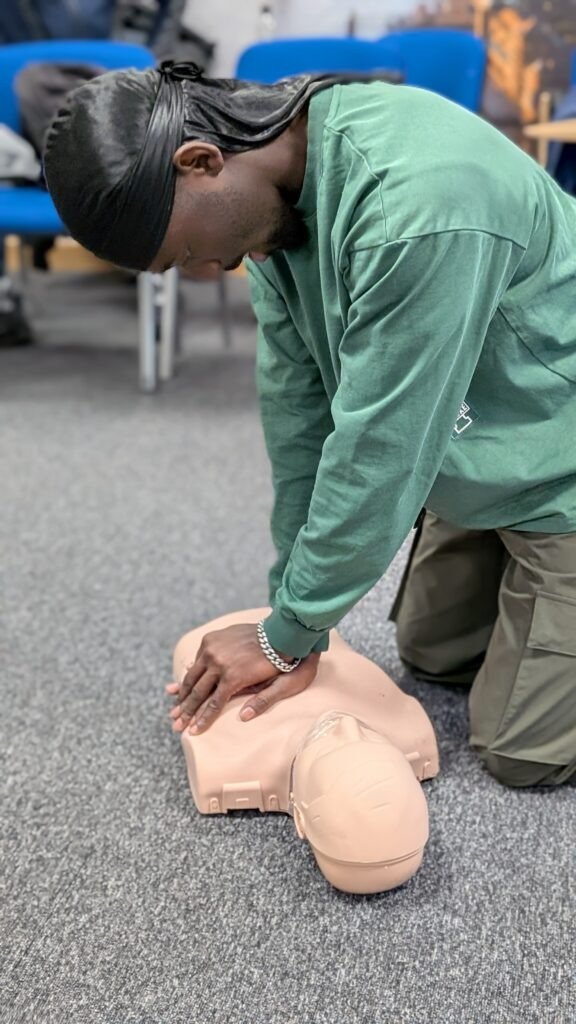
CPR/AED awareness is a good option for getting more people in the office to know the basics: recognising cardiac arrest, calling 999, starting CPR, and using an AED early. It supports a stronger emergency response culture across reception teams, floor wardens, managers and support staff. It isn’t usually a substitute for EFAW or FAW when a needs assessment shows trained workplace first-aiders are required, it works best as a supplement.
How to Decide Which CPR-Inclusive Course Your Office Needs
A few quick questions usually settle it:
- Is the office low-risk with a small headcount? EFAW is usually enough.
- Does the office have higher occupancy, multiple floors, or lone working? FAW gives broader cover.
- Do you want more staff confident in CPR basics beyond the designated first-aiders? Add CPR/AED awareness sessions alongside EFAW/FAW.
- Has a first-aid needs assessment been carried out recently? If not, that should come before choosing a course level.
- When do certificates need renewing? EFAW and FAW certificates are valid for three years, with annual refreshers recommended.
Booking CPR and First Aid Training
Get Certified Now delivers EFAW, FAW, and CPR/AED awareness training on-site, at our Hatton Garden / Holborn venue in London, or through blended learning, with practical assessment and written testing included. Contact Get Certified Now to book the right CPR-inclusive course for your office team.